


 Request More Information
Learn the Latest Skills
You can choose any course you are most interested in to gain new skills and expand your current skill set.


 Back
Back

Call Us:
+44 161 884 3134
Send Us Mail:
info@bestpracticetraining.com Get a Quote


Project Management


Programme Management


Business Analysis & Systems Development


Business Skills


Office Applications


ITIL® and IT Service Management


Technical IT Training


Health and Safety


PRINCE2® Training & Certification
Agile Project Management Training & Certification
APMP Training & Certification
Scrum Training & Certification
Change Management Training
MoP® Training
P3O® Training
Microsoft Technical
CompTIA Training
Cisco Certifications
CISSP Training & Certification
CISM Training
Citrix Training
Java Training
Oracle Training
Business Analysis Training & Certification
Software Testing Training
Lean Six Sigma Training & Certification
Six Sigma Training

Topic Introduction

Overview
The ITIL ® Training course starts off with a Foundation course and is followed by a Practitioner course to complete the training. The delegates can also choose to take up a single Foundation and Practitioner course that covers all the contents covered individually. The course benefits individuals such as IT professionals, Customers, and Users who are involved in the provision or receipt of IT Service Management.
ITIL training is split into two stages, Foundation and Practitioner. Candidates can complete these training courses together or separately, depending on what suits them. ITIL training courses are delivered by qualified, experienced trainers who have the candidate’s best interests at heart. Training is based on latest course materials, so candidates only learn the most recent and relevant information. ITIL Training candidates are provided with all the knowledge and resources they need to pass the ITIL Foundation and Practitioner exams.
Those who may benefit from ITIL training courses include IT professionals, IT service managers, and those involved in IT provision. Generally, anyone who works within IT will benefit from ITIL training courses.
Individuals who possess ITIL certifications experience many advantages. They:
ITIL Training is all about quality service management. Service management is essentially creating, controlling, and developing the services which assist the business and customers. Vital components such as networking, software, and suppliers must be strategically projected and enforced in order to work effectively. ITIL is very focused on making IT services central to how the business functions, whilst adapting such IT services to fulfil business needs.
ITIL is renowned worldwide and is used extensively by companies to manage all IT needs. ITIL Training is managed by AXELOS, the best practice advisors, who are used by major companies such as Microsoft, the NHS, and NASA. Hence, ITIL Training is credible and valuable to employers. ITIL certifications are also accredited by PeopleCert which adds to the integrity of the qualifications.
Our ITIL course will clear the concepts, processes, methods and principles related to ITIL. Certified professionals got more opportunities than one who is not certified. Get certified with us and explore new height in the industry. We offer our clients special offers and services along with fulfilling the requirements during the ITIL course.
Our training is based on the latest course materials. Our experienced instructor will help delegates to understand how to implement ITIL principles, methods, processes and techniques for improving the functionality into their organisation.
Our ITIL courses are accredited by PeopleCert. We have certified trainers who help the delegates to have a clear picture of the subject. We offer best price and services in the industry. Our help and support team is available 24/7 for handling the queries of the delegates. The ITIL courses on this page are offered by The Knowledge Academy, ATO/Affiliate of AXELOS Limited. ITIL is a registered trademark of AXELOS Limited. All rights reserved.
Best Practice Training is a prominent name among the global training providers for running high quality and unique training programmes. We provide courses in 410+ locations across 30+ countries with given below delivery methods:
The key to continuous growth in any field and profession is constant learning and improving your current skill set. Best Practice Training’s specially designed quality training programmes help you to achieve your desired objectives easily. We provide you with experienced and dedicated staff, advanced learning material and professional notes to enhance your learning experience and skills.
Intime is a design studio founded in London. Nowadays, we’ve grown and expanded our services, and have become a multinational firm, offering a variety of services and solutions Worldwide.
Business Strategy Growth
Finance Valuable Ideas

YEARS OF EXPERIENCES

Our training model addresses the training requirements of managers and leaders. We design the curriculum to fulfil the organisational needs and achieve business goals.

When providing training, our support staff clarifies the whole thing related to the process, including quantity, quality, time, cost and effectiveness, to ensure your satisfaction.

We provide engaging training programmes that are relevant to tackle modern business issues and get desired outcomes.


8 Courses
1 Course
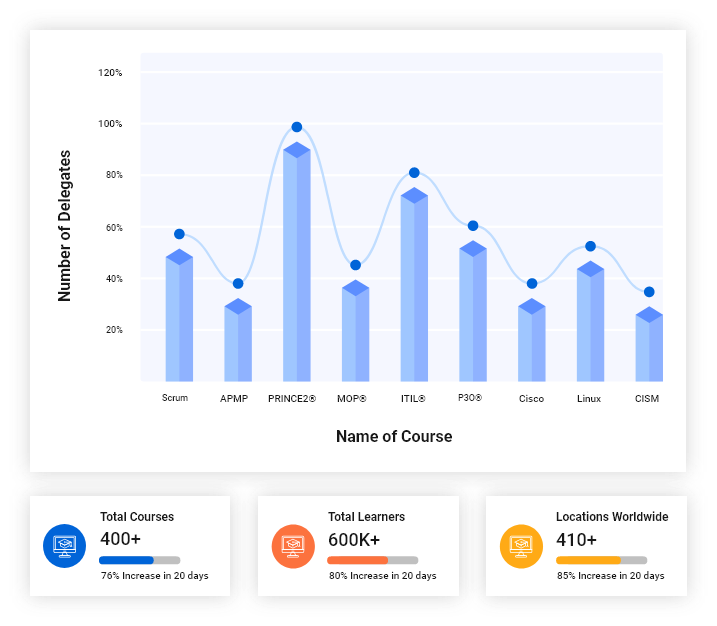
Best Practice Training is a globally recognised and renowned organisation for providing training of various accredited certifications. Join us today for enhancing your existing skills and knowledge in multiple fields such as IT Service Management, Project Management, Business Analysis, etc., which will also help you increase your career opportunities. We provide training in 410+ locations over 30+ countries, covering 400+ courses with four delivery methods.


You can choose any course you are most interested in to gain new skills and expand your current skill set.

After attending your desired course and enhancing your skill set, you will be ready to start a career in the field of your choice.

After completing the course, you will get the completion certification to validate your expertise in that particular skill set.
Best Practice Training provides specially designed training courses in 410+ locations spanning over 221+ countries globally. We provide amazing training centres and learning material to deliver an outstanding customer experience.


 View More